Why...
I’ve been running Night Nav workshops for a l-o-n-g time now, they’re some of the most popular cpd sessions we run; so I’ve brought this post over to the Wellness Walks website and updated it.
Night Nav –
It’s a skill that seems to cause stress to a lot of candidates – and one of the most common reasons for deferral if you’re doing a mountain leader course. It’s also the area where I regularly see the greatest skills fade in people who’ve qualified – it seems we seldom seem to practice once we’ve passed – and for a lot of ML’s actual ‘new’ navigation can be an infrequent thing.
So I thought I’d share some top tips….
Why does it cause so much stress?
The honest answer is almost certainly that you’ve not practised enough. It’s not a ‘black art’, it’s not mysterious – navigating at night is a skill, and like any skill it requires practice to master. To do it really well you need a rounded mix of techniques (tools) – and you need to know how to use them. Example; If all of your night navigation is pace on a bearing….well that’s a great skill and it’s foundational, but it isn’t enough.
So my first tip is a simple one;
Do the work. And yes that means going out on the crappy nights – when it’s raining, when the clag is in, even (especially) when Strictly is on. Assessment, or worse an emergency, won’t really care about the weather.
Know your Kit
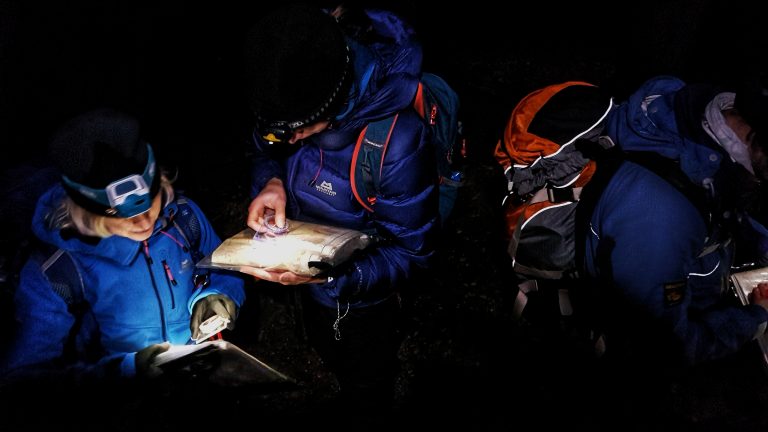
That might seem simple or obvious, but I’d estimate that half of the people who come on these sessions aren’t all that familiar with their kit, don’t have a system in place, haven’t tested it in the dark.
et a good torch, if you’re going to be doing navigation in the dark then it’s worth investing in*. Then find out what it can do – how far the beam actually goes, what that means for your vision and how to control it. Get an adjustable torch – find out which setting you can read a map with, which setting you need in fog or a whiteout. Then get a spare torch. Batteries are nearly impossible to change with wet hands in the dark on the side of a mountain…
* But…increasingly I’m seeing folks with ridiculously superpowered torches – 2000 lumen 400m beams might seem a good idea – but in typical UK wet weather you’ll find it more of a hinderance as it reflects back from wet air – make sure you’ve a wide low powered option as well!
Can you see your compass at night? Does the luminescence work – can you turn the dial without having to take your gloves off?
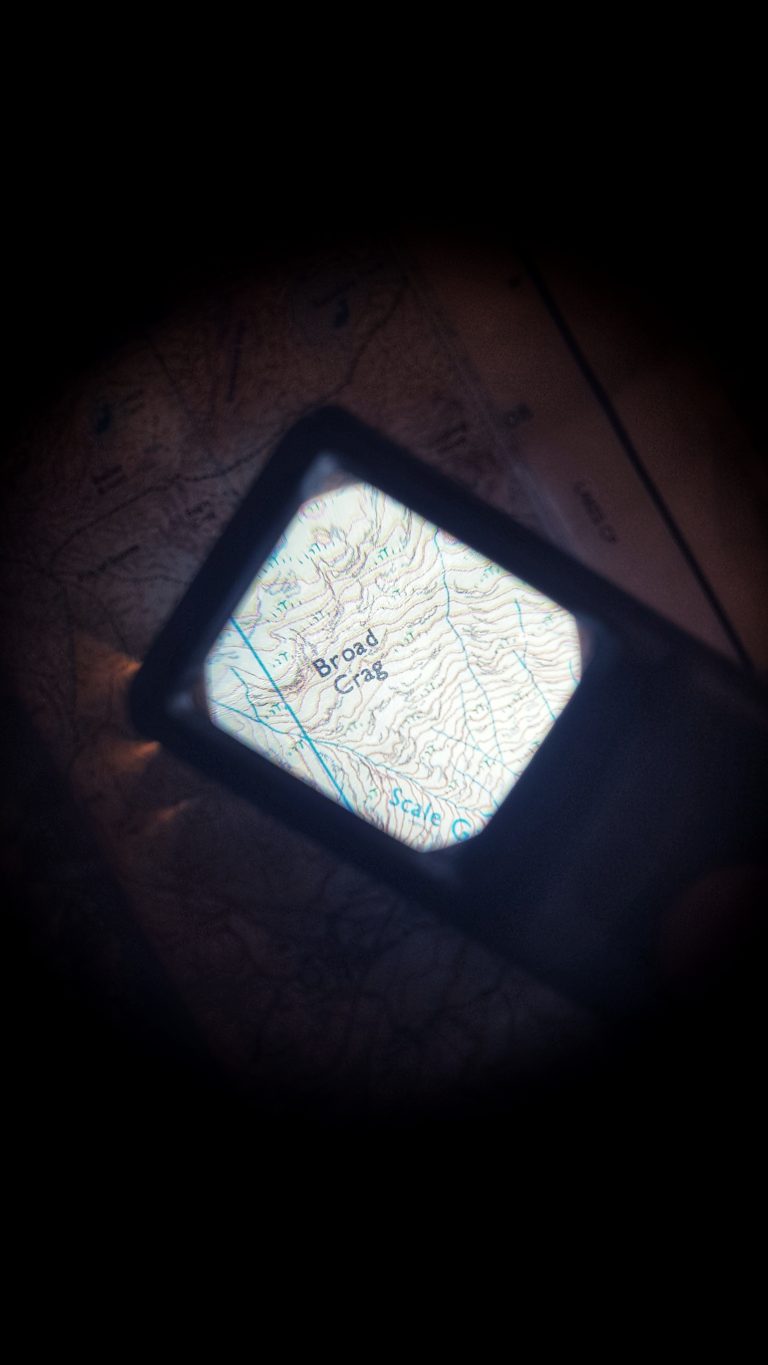
Can you actually see at night – many folk will find that their vision is poorer at night – I’ve invested all of £10 in an illuminated magnifying glass – its made a world of difference to my precision navigation – I’ve even attached a cut up piece of old chamois leather to its lanyard – no more fogged specs for me.
o you know what to wear at night? I know this may seem obvious – but at night you’ll be slower and won’t generate as much heat – you’ll feel the cold a lot quicker – it could be time for another spare layer in your rucksack.
Do you know how to use all the features on your watch? Sounds daft – I see it every session. Have a practice with using the stopwatch, the light – if you’re going to use an altimeter then make sure you know how to recalibrate it.
And then…have a system for all of this. Know where things go in the pack so that you find then first time. Put the things you need easily to hand. I keep a spare compass, spare torch, hat and gloves in the top of my sack – somewhere I can always find them in the dark. I set off in the gloaming with my torch in a jacket pocket – so I don’t need to stop for more kit faff later.
Attach everything. On the side of Blencathra in a 40mph wind with driving rain and the dying bracken blanketing the ground you’re very unlikely to find that dropped compass, glove, walking pole – and your night just got a lot harder. I recently worked an ML assessment and a candidate dropped their compass. It took 25 minutes to find – and by that time the level of stress the candidate was putting themselves under was immense – and in finding the compass they lost their sense of where they actually were – all stress and worry they didn’t need.
Know your numbers
In limited visibility your going to need to be really really solid on the basics, pacing and timing will become two of your best friends. But…they’re not going to be the same in the dark. We cover this a lot on our ‘Intro to Night Nav’ course – but its also something I see candidates slipping back into. Stressed in the dark it’s easy to remember your normal number of paces or how long it takes to cover 400m – so again go out, practice, and know what the numbers are for you. If this is tricky for you then write them down , maths gets harder under stress. Have a system for how you’ll adapt – I now grade my paces by difficulty & add 10% increases depending on how I think I’m adjusting my steps – uphill, bracken, rocks – even wet bog will all change your stride. At night everything is that little bit harder…. and five years later after ankle surgery – my paces have changed again! I still practice this every so often just to check.
Start out on normal ground in the dark – you may well be very close to daytime numbers if the visibility is good – but then move onto uneven ground. Now you’ll feel a need to look where you are going more carefully – simply walking will be a more engaging process and your step count (& timings) will alter. Next you can add in steep ground, maybe some adverse weather. It’s also worth noting that many mountain walkers don’t add time for going downhill – you may well find that you need to in the dark.
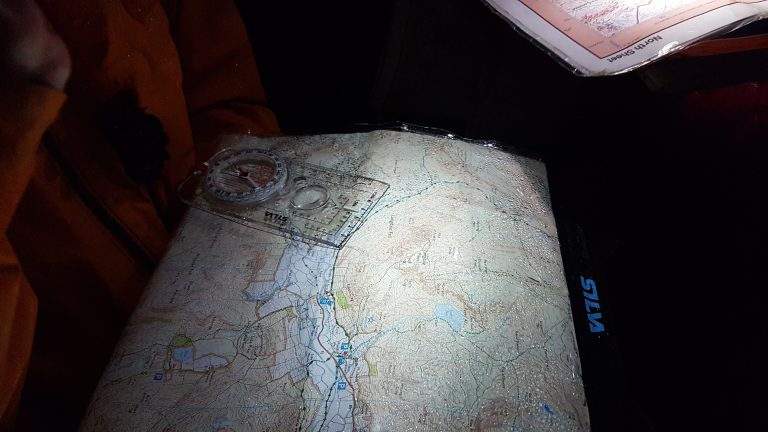
Pacing on a bearing
I can’t stress enough this shouldn’t be your only skill – but it is vital that you’re able to really rely on it when you need it.
In daytime navigation it’s easy to correct, being nearly accurate is usually good enough – but at night you need to be spot on. This will of course start by knowing your numbers – but there are several other factors to consider. I always try to break navigation legs down into smaller pieces – at night the object you sighted your bearing on can disappear for a multitude of reasons (visibility changes, uneven ground between you and the object, it’s not what you thought it was…) I once had a candidate who sighted on distant farm lights, which then started to move – she had taken her bearing on a sheep’s eye!
Know how to count your paces too – I use my fingers, a lot of people use beads on a string on the shoulder strap of my rucksack, I’ve seen people use clickers, and I’ve even seen a candidate write on their map margin – just have a system. In poor vis I’ll stop every <insert number that is applicable> paces to check on my group. If that’s what I’m doing I’ll stick with it for the whole leg & count for that number (eg I might move in 25m increments, or 100m etc).
Get your bearing right. If you’re starting from a strong feature it’s worth taking a back bearing whilst it’s still visible – or you can do this with a group member. I still kneel down and take my time on a bearing – because it’s worth it.
Feel the Ground with your body
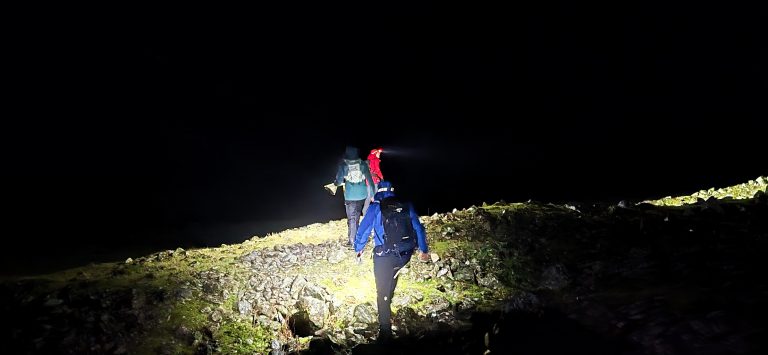
Contours are your friend in the dark – being able to feel the change of angle of a slope – where it steepens, lessens, levels out. Which way an incline runs – things we’re used to being able to see in the daylight, these all become more difficult to see at night – but with experience you can learn to feel them. You can tell uphill, down hill etc If you can master this then it’s another strong tool, it will let you traverse contours (move at same height) more easily, free up some brain capacity.
And I also use this term for how the going feels. I think we are (or should be) familiar with what ‘feels’ normal for us – so am I going at my usual pace? Does this ‘feel’ steeper than I expected?
Also understand what the real world is doing compared to the mental picture you built from the map. Many people are often flummoxed by minor features – the gully they weren’t expecting, the stream that’s not on the map etc. Pause an think – if the gully is actually only 4m wide – just how obvious would that actually be on the map? If its rained for weeks how many micro feature streams might appear? Everything feels like it looks different at night- so get really good at building your description.
Have a Strategy
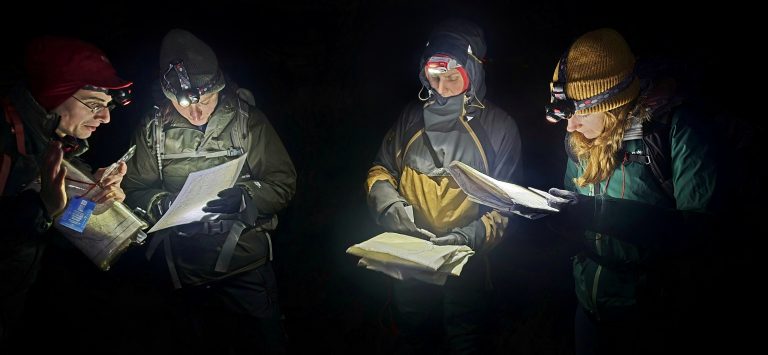
Now clearly this should apply to all of your navigation – but at night it’s vital. I said above I like to break legs down – what I’m trying to do is make them easier. So sure I could pace 1200m on a bearing, but its a lot easier to walk 900m in an approximate direction, hit a wall, follow it North for 300m till it reaches a stream and then take a bearing and pace the last 200m. Sure I’ve walked a bit further – but my strategy has made the experience less stressful, has hugely increased my chances of being accurate, and will almost certainly have actually been quicker.
Stick to your basics & for me this is the D’s of navigation – its the easiest thing in the world to ‘jump ahead’ or take the seemingly easy option – and suddenly your system is broken because you missed a step.
Did you really know where you were leaving (Departing) from? When you followed the stream to try and find the confluence did you take a bearing (Direction) to check it was the right stream? You decided on pacing but now the ground is awful – did you also work out a time (Duration)? Are you going uphill – was that part of your Description? Are you sure you know the difference between a spur or a hollow or a re-entrant? (Destination).
To have a strategy you need tools you can rely on – but you often don’t need many when you can see (or you’re using your phone lol), and they don’t all get used in the daytime when you can see things, and we often only use our ‘go to’ ones…
So we’re back to where we started.
Get out there and practice, I do.
Sharing is caring!