Every benefit from our graphic explained....
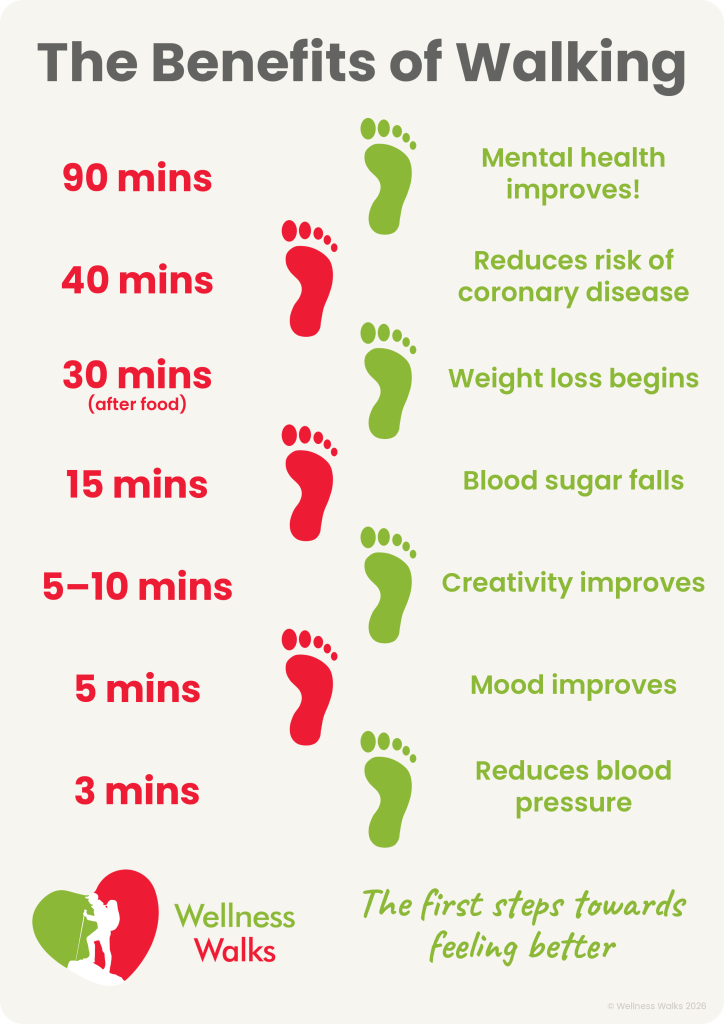
This graphic has informed and inspired us from day 1; so we thought we’d explain the science and evidence behind it – because every claim on our Benefits of Walking poster is backed by published research, and this article gathers it in one place.
At Wellness Walks we run totally free walks in the wonder of nature, led by trained community champions, to support people’s mental, physical and social health. Our poster sets out what happens to your body and mind as the minutes add up. We get asked where those numbers come from, so here are the studies behind each one, from the first three minutes to a full ninety.
We’ve linked every study so you can read it yourself. Where the research comes with a caveat, we say so.
3 minutes: reduces blood pressure
Three-minute walking breaks, taken regularly through the day, lower blood pressure compared with sitting still.
In a 2019 study published in the journal Hypertension, researchers at the University of Western Australia tested 67 older adults. On one day they did a 30-minute morning walk, then broke up the rest of the day’s sitting with three minutes of light walking every half hour. For women, those short breaks lowered blood pressure even further than the morning walk alone. The authors said the size of the drop approached what you’d expect from blood pressure medication. (ScienceDaily)
A separate study found that every pattern of short walking breaks it tested, from one minute an hour to five minutes every half hour, cut blood pressure by 4 to 5 points compared with eight hours of sitting. (NBC News)
The takeaway: the benefit comes from getting up and moving little and often. Three minutes every half hour is enough to make a difference.
5 minutes: mood improves
Just five minutes of activity outdoors in nature gives the biggest single boost to mood and self-esteem.
Researchers Jo Barton and Jules Pretty at the University of Essex pooled data from 1,252 people across ten UK studies, covering activities such as walking, gardening and cycling in green spaces. They found the largest improvement came in the first five minutes. The benefits kept going after that, just less dramatically. (EurekAlert / American Chemical Society)
Every natural setting helped, including parks in towns and cities, and places with water added something extra. People of all ages and backgrounds benefited, with the greatest changes seen in young people and people living with mental ill health. (Fox News / Reuters)
Short walking breaks during the day help mood too: in a separate study, regular walks of a few minutes reduced fatigue and lifted mood compared with sitting all day. (NBC News)
The takeaway: you’ll feel the difference within five minutes of stepping outside.
5–10 minutes: creativity improves
A short walk boosts creative thinking by around 60% compared with sitting.
In 2014, Marily Oppezzo and Daniel Schwartz at Stanford University ran four experiments with 176 people. The walking and sitting sessions lasted between 5 and 16 minutes, and on average people came up with 60% more creative ideas while walking. (Stanford News)
The act of walking itself made the difference: walking indoors on a treadmill worked almost as well as walking outside. The boost also lasted, with ideas still flowing when people sat back down after a walk. (Stanford Graduate School of Education) In one experiment, everyone who walked outside came up with at least one high-quality, original idea, compared with half of those sitting indoors. (Stanford News)
The takeaway: stuck on a problem? A ten-minute walk is one of the simplest ways to free up your thinking.
15 minutes: blood sugar falls
A 15-minute walk after each meal controls blood sugar as well as one 45-minute walk, and better after the evening meal.
In a 2013 study in the journal Diabetes Care, Loretta DiPietro and colleagues at George Washington University tested ten people aged 60 and over who were at risk of type 2 diabetes. Three short walks after meals worked as well over 24 hours as a single 45-minute walk at the same easy-to-moderate pace. After the evening meal, the short walk was significantly better at bringing blood sugar down for up to three hours. (ScienceDaily)
A 2022 review in the journal Sports Medicine, led by the University of Limerick, found that even 2 to 5 minutes of light walking after a meal helps smooth out blood sugar. It works best within 60 to 90 minutes of finishing eating. (Medical News Today) Across the studies reviewed, light walking breaks through the day cut blood sugar by an average of 17% compared with sitting. (KTVZ / CNN)
The takeaway: a stroll after dinner is one of the easiest healthy habits there is.
30 minutes (after food): weight loss begins
A 30-minute walk burns roughly 100 to 190 calories, and walking soon after a meal may make that walk count for more.
Harvard Health’s figures show a 30-minute walk at 3.5 mph burns about 107, 133 or 159 calories for people weighing 125, 155 or 185 pounds. Pick up the pace to 4 mph and that rises to roughly 135 to 189 calories. (Harvard Health)
Timing may matter too. Blood sugar peaks 30 to 60 minutes after eating, so walking straight after a meal uses that sugar as fuel. In a small 2011 report from a Japanese clinic, walking for 30 minutes straight after lunch and dinner led to weight loss over a month, while the same walks started an hour after eating made no difference to weight. It only involved two people, so treat it as a promising lead rather than proof. (PubMed Central)
The bigger picture is clearer. A review of trials in adults with obesity found regular brisk walking cut weight by about 2 kg, waist size by nearly 3 cm and body fat by about 2.6 kg on average. (University of Otago) A separate analysis found walking programmes lead to steady weight loss, with longer programmes losing more. (Annals of Family Medicine / PubMed)
The takeaway: your body burns calories from the very first step. Making a 30-minute walk after a meal a regular habit is a simple way to support a healthy weight.
40 minutes: reduces risk of coronary disease
The American Heart Association recommends 40-minute sessions of moderate exercise, such as brisk walking, three or four times a week to protect your heart.
The AHA advises an average of 40 minutes of moderate to vigorous aerobic activity, three or four times a week, to lower blood pressure, cholesterol and the risk of heart attack and stroke. High blood pressure and cholesterol are the main drivers of coronary heart disease. (Medical Xpress / HealthDay)
Long-term studies back this up. A 2009 review of walking studies found that every extra 30 minutes of normal walking a day, five days a week, was linked to a 19% lower risk of coronary heart disease. (PubMed) A study following nearly 90,000 women over 50 for ten years found that those who walked for 40 minutes or more had a 21–25% lower risk of heart failure than women who took shorter walks. (MyFitnessPal)
The takeaway: three or four 40-minute walks a week is a heart-healthy routine, straight from the cardiologists.
90 minutes: mental health improves
A 90-minute walk in nature reduces the repetitive negative thinking linked to depression and anxiety, and calms the part of the brain involved.
In a 2015 study published in PNAS, Gregory Bratman and colleagues at Stanford University sent 38 people on a 90-minute walk, either through green countryside or along a busy city street. The nature walkers reported less rumination afterwards and showed reduced activity in a brain area linked to the risk of mental illness. The city walkers showed no such change. (University of Washington Nature and Health) It was a small study, and the researchers called for more work to confirm it. (Medical Xpress)
A much larger study supports the bigger picture. Researchers at the University of Exeter looked at nearly 20,000 people in England and found those who spent at least 120 minutes a week in nature were significantly more likely to report good health and wellbeing. It didn’t matter whether that came in one long visit or several shorter ones. (Neuroscience News) Experimental work shows time in nature lowers heart rate, blood pressure and the stress hormone cortisol. (Psychology Today)
The takeaway: a longer walk in green space does more than lift your mood. It changes how your mind works, and a 90-minute walk gets you most of the way to your weekly dose of nature.
Take the first steps with us
Every one of these benefits starts with getting out of the door, and you don’t have to do it alone.
Wellness Walks are totally free, led by trained community champions, and designed to support your mental, physical and social health. Our walks run from the Scottish Highlands to Hertfordshire and across Wales, and our interactive map on the Find a Walk page shows what’s happening near you.
The first steps towards feeling better.
Sources
- Wheeler, M. J. et al. (2019). Effect of morning exercise with or without breaks in prolonged sitting on blood pressure in older overweight/obese adults. Hypertension. Summary
- Barton, J. & Pretty, J. (2010). What is the best dose of nature and green exercise for improving mental health? A multi-study analysis. Environmental Science & Technology, 44(10). Summary
- Oppezzo, M. & Schwartz, D. L. (2014). Give your ideas some legs: the positive effect of walking on creative thinking. Journal of Experimental Psychology: Learning, Memory and Cognition, 40(4). Summary
- DiPietro, L. et al. (2013). Three 15-min bouts of moderate postmeal walking significantly improves 24-h glycemic control in older people at risk for impaired glucose tolerance. Diabetes Care, 36(10). Record
- Buffey, A. et al. (2022). The acute effects of interrupting prolonged sitting time in adults with standing and light-intensity walking on biomarkers of cardiometabolic health. Sports Medicine, 52. Summary
- Harvard Health Publishing. Calories burned in 30 minutes for people of three different weights. Table
- Hijikata, Y. & Yamada, S. (2011). Walking just after a meal seems to be more effective for weight loss than waiting for one hour to walk after a meal. International Journal of General Medicine, 4. Full text
- Richardson, C. R. et al. (2008). A meta-analysis of pedometer-based walking interventions and weight loss. Annals of Family Medicine, 6(1). Abstract
- Brisk walking and body composition in adults with obesity: meta-analysis. University of Otago. Record
- American Heart Association physical activity recommendations, via HealthDay (2018). Article
- Zheng, H. et al. (2009). Quantifying the dose-response of walking in reducing coronary heart disease risk: meta-analysis. European Journal of Epidemiology, 24(4). Abstract
- Bratman, G. N. et al. (2015). Nature experience reduces rumination and subgenual prefrontal cortex activation. PNAS, 112(28). Summary
- White, M. P. et al. (2019). Spending at least 120 minutes a week in nature is associated with good health and wellbeing. Scientific Reports, 9. Summary
- Diaz, K. et al. (2023). Breaking up prolonged sitting to improve cardiometabolic risk. Medicine & Science in Sports & Exercise. Summary
Sharing is caring!